



Good morning,
This was the week governance stopped trailing the technology and tried to catch it. The frontier did not advance in a laboratory - it advanced in a conference room, where the people who build the most powerful AI systems sat as equals to the people elected to govern them.
At the G7 in Évian, heads of state and lab chiefs shared a lunch and a problem neither can solve alone. In Washington, a federal bargain emerged to trade a safety regime for control of the states. In Brussels, the rulebook held its line. And at the United Nations, the world prepared its first collective attempt to govern AI together. The through-line is unmistakable - the contest is no longer only about who builds the most capable systems, but about who can govern, and even understand, what has already been built.
Here is your weekly five-minute distillation of the 10 most consequential movements in AI governance.
1. AI Takes a Seat at the Table: The G7 Évian Summit Puts Frontier Labs Alongside Heads of State
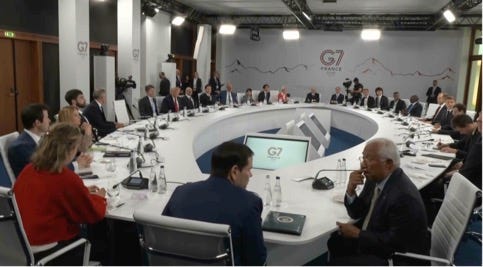
THE BIG DEAL At the G7 summit in Évian-les-Bains from 15 to 17 June, the leaders of the world’s frontier AI laboratories joined heads of government for a working lunch - Sam Altman, Dario Amodei and Demis Hassabis among roughly a dozen lab chiefs. On the final day, leaders issued a call for a safer digital space for minors and a package of voluntary commitments covering child safety and frontier risk in cyber security and biology, extending the 2023 Hiroshima AI Process. The United States blocked binding governance language, leaving the communiqué anchored to non-mandatory OECD principles.
TAKEAWAY The defining image of AI governance in 2026 is private executives seated as peers to elected leaders. Boards should read the Évian commitments as the emerging global baseline for responsible AI behaviour - voluntary today, but the reference standard that regulators, courts and procurement teams will cite tomorrow. Map your AI vendors against the child-safety and frontier-risk pledges now.
SOURCE Élysée - Outcomes of the Évian G7 Summit
2. The Kill Switch Becomes Doctrine: Washington Weighs a Trusted-Partners Scheme for Allied AI Access
THE BIG DEAL Days before Évian, a United States export-control directive forced Anthropic to suspend its most capable models for foreign nationals - and, unable to filter users by nationality, the company withdrew them worldwide, taking them offline across more than one hundred countries. At the summit, G7 leaders discussed a trusted-partners framework to restore allied access to restricted American models, with President Macron warning that nations will not buy AI they fear can be switched off without notice. No final framework had been agreed as of 18 June.
TAKEAWAY Model access is now an instrument of statecraft, governed by alliance politics rather than open markets. Australian agencies and enterprises building on United States frontier models must treat continuity of access as a board-level risk - securing contractual protections, fallback provisions and, where feasible, sovereign or allied alternatives before a directive lands, not after.
SOURCE Anthropic - Statement on Fable 5 & Mythos 5 Suspension
3. America’s Federal Gambit: The Great American AI Act Offers a Safety Regime in Exchange for Freezing State Laws
THE BIG DEAL On 4 June, Representatives Jay Obernolte and Lori Trahan released a 269-page bipartisan discussion draft, the Great American AI Act, proposing the first comprehensive federal AI safety framework - semi-annual third-party audits, published frontier-safety frameworks, whistleblower protections and penalties of up to US$1 million per day for the largest developers - in return for a three-year freeze on state laws governing how models are built. It follows December’s executive order and a Department of Justice task force already challenging state statutes in court. Colorado’s AI Act takes effect on 30 June.
TAKEAWAY The United States is attempting to trade a federal safety floor for pre-emption of its own states - a bargain still far from law. For multinationals, the American compliance map remains fragmented and contested into 2027. Track both tiers: the federal draft signals where audit and frontier-disclosure obligations are heading, while Colorado and California’s live statutes set the near-term bar.
SOURCE White & Case - State AI Laws Under Federal Scrutiny
4. Brussels Holds the Line: AI Act Transparency Duties Arrive on 2 August as the Content-Labelling Code Lands
THE BIG DEAL With the G7 declining to give it cover to delay, the European Commission confirmed it will enforce the AI Act on schedule. The Act’s transparency obligations under Article 50 - including disclosure when users interact with AI, and machine-readable labelling of synthetic audio, image, video and text - apply from 2 August 2026. On 10 June, the Commission published its Code of Practice on marking and labelling AI-generated content to guide compliance, and Member States must stand up at least one regulatory sandbox.
TAKEAWAY Any organisation whose AI outputs reach EU users is in scope, regardless of where it is headquartered. Disclosure and content-provenance labelling are no longer roadmap items - they are weeks away. Inventory every customer-facing AI system and generative output now, and confirm your providers can mark content in a machine-readable format ahead of August.
SOURCE European Commission - Regulatory Framework for AI
5. The First Amendments Bite: the EU Bans AI-Generated Abuse Imagery and Defers Its High-Risk Duties
THE BIG DEAL The Digital Omnibus - the first set of amendments to the AI Act, provisionally agreed on 7 May - introduces two new prohibited practices: AI systems that generate or manipulate non-consensual intimate imagery, and AI-generated child sexual abuse material, both banned from 2 December 2026. In the same package, the headline high-risk obligations for Annex III systems such as recruitment, credit scoring and law enforcement are deferred from August 2026 to 2 December 2027, buying providers roughly sixteen additional months.
TAKEAWAY Europe is tightening at the edges while easing the centre - hardening prohibitions on the most egregious harms even as it relieves timeline pressure on mainstream high-risk systems. The deferral is planning relief, not a reprieve: the December 2027 anchor is firm, the new prohibitions are absolute, and the penalties - up to €35 million or 7 per cent of global turnover - are unchanged.
SOURCE Covington - EU AI Act Update: Timeline Relief and New Prohibitions
6. The World Tries to Agree: the UN’s First Global Dialogue on AI Governance Convenes in Geneva
THE BIG DEAL The inaugural Global Dialogue on AI Governance opens in Geneva on 6 and 7 July, alongside the AI for Good Summit, with preparations intensifying this week. Its centrepiece is the first report of the Independent International Scientific Panel on AI - forty experts serving in their personal capacity, co-chaired by Yoshua Bengio and Maria Ressa - intended as an IPCC-style evidence base for AI policy. The United States, which voted against the panel’s establishment, continues to oppose multilateral AI governance.
TAKEAWAY A durable international governance layer is forming around shared evidence rather than shared rules - and the major powers are split on whether to join it. For Australia, an active multilateralist, the dialogue is a venue to shape interoperable standards and align with the panel’s assessments. Watch the panel’s first report: it will become a reference that other regulators cite.
SOURCE United Nations - Global Dialogue on AI Governance
7. Sovereignty by Construction: the EU Backs an Open-Source Frontier Model in All 24 Official Languages
THE BIG DEAL On 19 June, the European Commission named the EUROPA consortium as winner of its Frontier AI Grand Challenge - a project to build a European open-source frontier model spanning all twenty-four EU languages. The award sits within a broader tech-sovereignty package the Commission proposed on 3 June to reduce dependence on non-European AI, and it lands directly against the backdrop of allied anxiety over United States export controls.
TAKEAWAY Europe’s governance answer to model dependence is to build an alternative it controls. Expect sovereign-model programmes to multiply as access risk climbs the political agenda. For boards, a credible European open-source frontier option could, over time, ease single-vendor and jurisdictional exposure - though production-grade parity remains the open question.
SOURCE European Commission - Regulatory Framework for AI (Newsroom)
8. Australia Stands Up Its AI Safety Institute - With Advice, Not Authority
THE BIG DEAL Australia’s Artificial Intelligence Safety Institute, backed by A$29.9 million, is moving from announcement to operation through 2026, tasked with monitoring, testing and advising on emerging AI capabilities, risks and harms. It anchors the keeping-Australians-safe pillar of the National AI Plan, which - confirmed in December - relies on existing, technology-neutral laws and sector regulators rather than a standalone AI Act or mandatory guardrails. The Institute’s remit is advisory, with no mandatory testing powers.
TAKEAWAY Australia has chosen capability over codification: an evaluator and adviser rather than a regulator with teeth. The bet is that existing laws plus expert testing can keep pace. For boards, the practical signal is that scrutiny will arrive through sectoral regulators and the Institute’s assessments - not a single AI Act - so demonstrable governance maturity, not box-ticking, is what will be examined.
SOURCE Dept of Industry, Science and Resources - Australian AI Safety Institute
9. Training Data on the Table: Australia Rejects an AI Copyright Exemption and Turns to Licensing
THE BIG DEAL Australia has declined to create a text-and-data-mining exemption for AI training - a change sought by technology firms - and is instead pursuing a paid licensing model through the Copyright and Artificial Intelligence Reference Group within the Attorney-General’s Department. The Productivity Commission has urged a three-year review before any AI copyright exemption, while the Government weighs legal certainty for AI-generated outputs and a small-claims forum for lower-value disputes.
TAKEAWAY Australia is siding with rights holders over frictionless training data, signalling that lawful provenance of training material is becoming a governance expectation rather than an afterthought. Organisations building or fine-tuning models on Australian content should assume licensing - not exemption - is the direction of travel, and document the provenance of their training data accordingly.
SOURCE Attorney-General’s Department - Copyright and AI Reference Group
10. From Safety to Science: the West’s AI Institutes Regroup as a Global Evaluation Network
THE BIG DEAL The international coalition of state AI bodies - relaunched in December as the International Network for Advanced AI Measurement, Evaluation and Science - is consolidating as the technical backbone of allied AI governance, linking the testing capacity of the United States, United Kingdom, Singapore, Australia and others. Its renaming signals a deliberate pivot from broad safety framing towards rigorous measurement, evaluation and benchmarking of frontier systems - precisely the capability the Évian export-control dispute exposed as scarce.
TAKEAWAY As this week’s thought piece argues, the decisive governance capability is no longer owning models but understanding them - and the network is where that capacity is being pooled. For governments and large enterprises alike, investment in independent evaluation - red-teaming, benchmarking, verification - is shifting from a technical nicety to a strategic necessity.
SOURCE Dept of Industry, Science and Resources - Strengthening AI Safety
The Executive Verdict
The week’s events trace a single fault line. Capability now sits largely in private hands, while accountability is being assembled - unevenly - across summits, statutes and standards bodies. The G7 offered commitments without bindings; Washington offered a federal floor in exchange for silencing its states; Brussels offered enforcement on schedule; and the United Nations offered evidence in place of agreement. Each is a different answer to the same question: how does a democratic system govern a technology it does not fully understand and does not entirely control?
For Australian boards and agencies, the lesson is to stop waiting for a single, settled rulebook - it is not coming. Govern to the strictest standard you touch, because extraterritorial regimes such as the EU AI Act will reach you regardless of where you sit. Build the capacity to evaluate the systems you depend on, rather than trusting the assurances of those who sell them. The organisations that lead through 2027 will treat understanding - not merely ownership - as the strategic asset it has become.
WEEKLY THOUGHT PIECE
The Problem of Unknowable Power: Why Understanding AI May Matter More Than Owning It
By Andrew Horton · 22 June 2026
At the Group of Seven summit in Évian-les-Bains this month, the most consequential gathering took place away from the main table.
While presidents and prime ministers worked through the formal agenda, a working lunch brought together the leaders of the world’s frontier artificial intelligence laboratories alongside heads of government. Sam Altman sat beside Donald Trump, while Dario Amodei and Demis Hassabis occupied seats once reserved for national leaders. Ministers and senior officials crowded the room, and the discussion drew as much attention as the summit itself.
The symbolism mattered. A small group of private executives now commands influence once associated with sovereign states because the systems they build increasingly shape economic competitiveness, military capability, scientific progress and public administration.
Much of the commentary focused on sovereignty. Should nations rely on models developed elsewhere? What risks arise when critical capabilities sit within a handful of firms? What happens if access is restricted, degraded or withdrawn?
These questions matter.
They also point towards a deeper shift that is beginning to redefine the structure of power itself.
For four centuries, power was broadly calculable. States estimated the size of armies, the output of factories, the strength of economies and the yield of weapons with increasing precision. Intelligence was never perfect, yet competition unfolded within shared assumptions about capability. Governments disagreed about intentions while maintaining a broadly common understanding of means.
The modern international system rests on that foundation.
Artificial intelligence is beginning to challenge it.
Days before the Évian summit, that challenge came into sharp focus.
Following concerns regarding the security implications of Anthropic’s most advanced models, the United States Commerce Department reportedly issued an export-control directive requiring the suspension of access for foreign nationals. Because the company could not reliably distinguish users by nationality, the effect extended globally. Within hours, the models went offline across more than one hundred countries.
The details matter less than the broader lesson.
Senior government officials, intelligence agencies, company executives and outside experts all appeared to hold different views about the nature and significance of the capability in question. Government assessments pointed to a serious concern. The company offered a narrower interpretation. Independent analysts disagreed among themselves.
A decision with global consequences ultimately rested on competing technical judgements regarding what a single system could actually do.
This episode highlights a defining characteristic of frontier AI.
Strategic decisions increasingly depend upon systems whose capabilities remain only partially understood, including by those closest to them. The challenge is no longer simply the power of these systems. It is the difficulty of characterising that power with confidence.
Earlier generations of technology followed a different logic. Engineers worked with known tolerances. Military planners operated within defined performance envelopes. Nuclear strategy relied upon calculable yields and verifiable stockpiles.
Frontier AI evolves through large-scale training rather than explicit specification. Researchers observe behaviour, test performance and refine outputs, yet they do not produce a complete inventory of capability. New behaviours emerge after deployment. Performance shifts across contexts. Outcomes vary according to prompts, environments and use cases.
Capability unfolds over time.
The strategic challenge is not merely that these systems are powerful. It is that consequential capability may exist before institutions can confidently define its limits.
For centuries, uncertainty centred on intention. States assessed known capabilities and debated how adversaries might use them. Artificial intelligence introduces uncertainty into capability itself. Decision-makers must increasingly evaluate systems whose full range of behaviour remains only partially mapped.
That distinction carries profound consequences.
Strategy depends upon reliable assessments of relative power. Governments allocate resources, build alliances and develop doctrine based on expectations of what competitors can achieve. When capability becomes fluid, evolving and difficult to bound, the risk of misjudgement increases.
The implications extend well beyond national security.
Economic performance increasingly depends upon systems whose behaviour evolves over time. Public administration, critical infrastructure and corporate decision-making are becoming reliant upon technologies that continue to develop after deployment. Organisations are integrating capabilities that remain only partially characterised and whose future performance cannot always be predicted with confidence.
Reliance expands even as understanding struggles to keep pace.
This reality exposes a limitation in many current policy debates.
Governments around the world are investing heavily in sovereign compute, sovereign infrastructure and sovereign models. These investments address legitimate concerns regarding access, resilience and dependence.
Yet ownership alone does not solve the deeper problem.
A government may own a frontier model while continuing to discover what it can do. Conversely, an organisation with sophisticated evaluative capacity may understand both its own systems and those of its competitors more thoroughly than the owners themselves.
The emerging contest therefore carries an increasingly important epistemic dimension.
Advantage will belong not simply to those who possess the most capable systems, but to those who can understand, evaluate and verify those systems most effectively.
At present, this capability remains scarce.
Many governments lack the technical expertise, computational resources and institutional frameworks required for independent evaluation. Regulators rely heavily on information provided by developers. Political leaders often make decisions based on competing claims advanced by companies, researchers and international partners.
This creates a form of strategic vulnerability.
A government that depends on external interpretations to understand critical technologies has effectively outsourced a core element of strategic judgement. Decisions increasingly rely upon perspectives shaped by different incentives, priorities and commercial interests.
A government that develops strong evaluative capacity occupies a fundamentally different position.
It can test systems directly. It can compare claims against observed behaviour. It can develop an evidence-based understanding of technologies that increasingly influence national outcomes.
Most importantly, it can exercise sovereign judgement in a domain defined by uncertainty.
Strong evaluative capacity also improves resilience, enabling institutions to respond more effectively when systems behave unexpectedly or access is disrupted.
The lesson from Évian extends beyond the influence of technology companies. It points to a deeper transformation in strategic competition. The central challenge of the coming decade will not simply be acquiring advanced AI systems but understanding them.
States will continue to invest in compute, talent, infrastructure and model development. These investments remain essential and will define the baseline of capability.
Increasingly, however, competitive advantage will depend on something else: the ability to identify emerging capabilities, evaluate performance independently and generate trusted judgements about rapidly evolving systems.
A new layer of strategic capacity is emerging: independent testing regimes, specialised expertise and institutions capable of producing trusted assessments under conditions of uncertainty. These capabilities will underpin more disciplined decision-making, more credible risk assessment and more stable strategic interaction.
For centuries, sovereignty rested on the ability to measure the instruments of power. States counted armies, measured industrial output and estimated nuclear arsenals with increasing precision. Strategy began with knowledge grounded in observation and verification.
Frontier artificial intelligence is reshaping that foundation. States now operate in a domain where capability evolves alongside understanding and where judgement must often precede certainty.
The emerging competition therefore extends beyond a race to build more powerful systems. It is becoming a race to understand them.
The governments that recognise this shift will invest not only in capability, but in the institutions that generate insight. They will develop the means to understand both their own systems and those of their competitors with speed and independence.
Those that do so will help shape the next phase of technological competition. Those that do not will increasingly act on the interpretations of others.
In an era where capability does not always present itself in measurable form, understanding becomes the decisive form of power.
Every Story Above Has a Governance Risk Score. Do You Know Yours?
AI governance fractured into competing regimes this week - voluntary G7 commitments, a contested United States federal bargain, hardening European rules and a nascent United Nations dialogue. Australian boards now face overlapping and extraterritorial obligations that no single jurisdiction defines.
Trust4AI is Australia’s purpose-built AI Governance Platform - designed around the S8 Framework to systematically rate, monitor and verify every AI system your enterprise deploys. From EU AI Act transparency duties and frontier-disclosure obligations to vendor model-access risk and independent evaluation, Trust4AI turns a fragmenting global rulebook into measurable, boardroom-ready controls.
What the Trust4AI Platform delivers:
› Automated S8 Framework compliance scoring for every AI vendor and deployment
› Independent verification and evaluation aligned to international AI measurement standards
› Real-time risk monitoring across EU AI Act, export-control exposure and data sovereignty
› Boardroom-ready audit trails and reporting for General Counsel and non-executive directors
› Continuous alignment updates as domestic and international regulation evolves
Stop reading about AI risk. Start governing it.